When I was about 10 years old, playing in my apartment building lobby, I encountered a neighbor that was not quite like the other kids who lived in the building. "Not quite" because in my child's mind the whole world was Dominican. I can't remember his name today, but he was an Indian boy who had recently moved in. We instantly became friends. The unfamiliarity of this new immigrant inner-city environment bonded us. Like all kids, we played all kinds of games and went over each other's houses.
I remember going into his apartment and like for every young child, each new experience is like going through an overgrown maze/puzzle embedded with the sensation of the four senses. Going over to his house allowed me to see into a new culture, which was not too unlike my own. Like in my apartment, his mom would spend time in the kitchen. The spices filled the air in the rooms (I thought of it as an Indian Sazon) the music his mother played sounded melodically rich and reminded me of the boleros or bachatas played at my house.
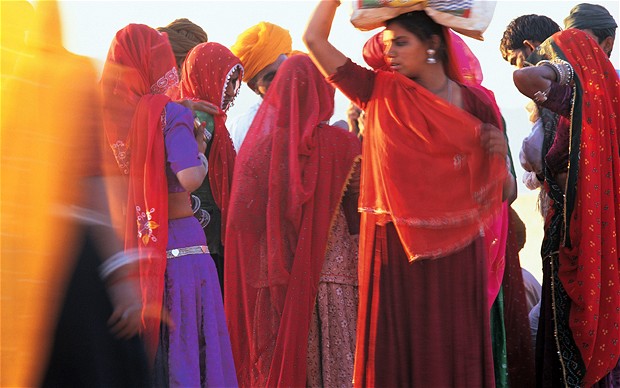
One day while playing hide-in-seek, I encountered a multitude of colorful clothing. Astounded I looked around and swirl the clothes, while making sure I didn't break anything. I didn't want to get in trouble. I loved looking at his mother's clothes, especially the long shawls (sometimes see through) his mom wrapped around her mid-body. These colors brought me back to my childhood island, but also took me on a journey to experience another black culture.
 |
| Indian Women Wearing Individual Saris |
Eventually, my friend moved and I never heard from him again, but I never forgot his mother's closet and I yearned to find styles like it. Years later, I found Little India, right here in NYC! I saw Tunics, skirts and scarves among other clothing styles. I was particularly drawn by the scarves, since I was already regularly head-wrapping as part of my righteous culture. From speaking to many wonderful Muslim and Hindu women I met, they taught me about the different types. I was particularly drawn by the Sari Shawls, exactly like the ones I'd seen in my friend mom's closet, which usually came accompanied with a set of clothing. I first started purchasing individual Saris and Pashminas. Eventually, one of the women I met, told me about a technique some women used when their Saris became worn or damaged. They saved their Saris and eventually sewed them together to make one scarf with these amazing strips of fabric. Each individual Sari was cut into a strip of a certain width and then they were stitched together creating blends and combinations of colors. The richness of the colors and the soft texture of the scarves provided a real treasure for the women because now they didn't have to throw away these pieces of cloth/fabrics.
Because of my head-wrapping practice, I endlessly thought about how these pieces of recycled Saris would look as headscarves. Although the women shared this sewing tradition with me, this particular group of women didn't actually know any seamstresses actively making Sari scarves in the U.S. So, I made it my mission to learn to make them myself or find them. I started searching online, until I found wholesale Saris available, as well as recycled big pieces of original Saris that could be used to make scarves. I am still self-teaching how to make them, but I have found sellers on Ebay who sell them at great prices.
What I particularly appreciate about Sari scarves is that with each, there is a collective story waiting to be shared by the woman who ends up with the scarf and wears it. Each Sari was previously owned by a woman living somewhere in the world, who's energy became embedded into this piece of fabric. So, when we fuse together parts of different fabrics, an explosion of sorts takes place. Not only by the left-over trails of thoughts and lived experience of its previous owner, but in how the new owner will internalize these to make new stories both in her designs/styles and her new experiences while wearing the scarf. I have fully embraced the concept and live it out with my own Sari scarves. With each different design, places I wear it, and people I meet, my Sari scarves became a part of new stories waiting to be shared.
 |
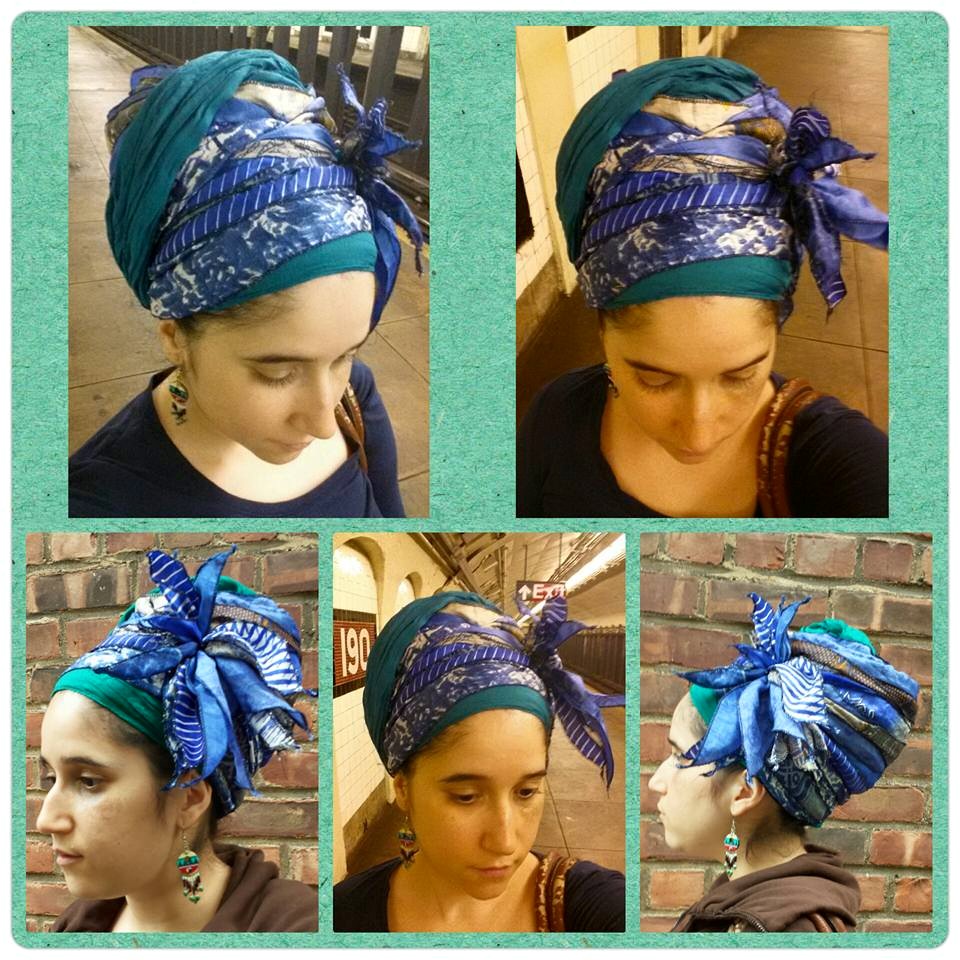
| Peacock Crown |
The blue Sari used for the "Peacock Crown" above is a luscious soft scarf filled with variations of blue. The name of the crown was inspired by the feathers of the peacock and how the male erects them to attract attention from its female counterparts. Using the end tails, after wrapping at an angle, I was able to use the remaining last 1/3 of the scarf to create the erect feathers effect. Using a thin scrunchie, I tied the scarf and then opened up the ends in a circular rotation. The strip of sari that has white stripes just added great detail and helped to enhance the "feathers." This is the new story I created with this crown design. The ever-ending story of male showing and proving their superiority, strength and other qualities to attract a woman that will chose him as her partner/mate. It's one of the many manifestations of Yin Yang in nature.
 |
| Potpourri Crown (1st Sari Variation) |
When I looked at the varying shades of yellow with certain orange tones, I felt the cool breeze right as the sun kisses one's skin with its warmth. This feeling only occurs during Autumn and that was what I first felt when I held the Sari. In particular, I thought of the dried falling leaves and petals that characterizes this season. With each falling leaf you are told that nature will be active in other forms that are not readily visible to the naked eye. The announcement of winter, is the preparation of nature to go "indoors" to keep warm and set up a proper "coat" for protection from the harshness of the cold. With the Potpourri Crown, I wanted to capture that image of the collection of these dried leaves and spices together in an intertwining style that is the braid. Nature is now indoors, literally, in my home providing fragrance and beauty during a time where it hides it. This is the cycle of nature. It is everywhere and it serves a purpose where-ever it is present. The bun at the top of the crown signifies this ability of the earth to recreate itself each time. This is the new story that this yellow Sari is telling.
 |
| Sprouting Roots Crown (2nd Sari Variation) |
This second Sari variation, called "Sprouting Roots" Crown, tells the story of another season: Spring. Ironically, Spring is not too different from Fall. It is another season that marks transition. A change to come in the earth's environment. The temperature is pretty much the same, only that instead of cool, you feel the warm air entrapping you while blossoms ranging from white, pink and purple gives signs of the fertility of life. Spring also signifies that life is becoming visible again. The weather is accommodating for nature to do what it does outwardly. This outpouring of life, movement and visibility is the imagery attempted to be captured by this crown. The top part is the earth uprooting itself and expanding, signifying regrowth. It's roots are sprouting throughout the back of my head reaching the sides of my shoulders. The sprouting effect is created by placing the Sari on top of the head, folding the middle of the tails at the top of the forehead and using a scrunchie tying the tails and placing them the side of one of the shoulders.
 |
| Grand Canyon Crown (Third Sari Variation) |
I've never been to the Grand Canyon and seen it with my own eyes. But this natural monument, is a wonder to watch even in pictures. It's intricate rough brown/reddish terrain has a meditative quality to it. It's design embodies a naturally occurring pyramid. It also gives you information about the past. Water is an extremely powerful element. Unlike fire, we can't see it's power immediately, but water is capable of eroding, carving, and changing earth throughout time. It is the wisdom that water represents which is left behind in this beautiful geological manifestation of our Earth. This awe-inspiring design is what stayed with me most. My attempt and capturing just one detail of the grand-canyon and telling the story of the water that once roam and carved many of its pathways, was the purpose of this crown. The yellow Sari served perfect for this because of its orangy and brownish parts. The flat but wave-like areas of the crown encapsulates just a minuscule component of the grand-canyon and the prints its water left behind. To capture this relationship of motion I wrap from the bottom up and then folded the last 1/3 of the tails into the flat component at the top.
 |
| Butterscotch Crown |
I've never liked the taste of butterscotch candy. It was one of those candies given out in Halloween, and that you kept to eat last when all the other fun, good candy ran out. Butterscotch seem to be in a lot of my candy memories as a child. They were always a component of any candy stack and so upon completion of this crown, I named it Butterscotch. It captures the feeling of mild excitement I felt upon consuming it. That's the purpose of the side twist with the beige scarf. The color and the small twist represents that mildness-that the flavor is not horrible, but it still is uneventful. What truly gives the crown the butterscotch feel to it, is this smaller Sari (it's not as wide as other Saris because less strips of fabric were sown together), which encompassed a spectrum ranging from coral to peachy colors. The contrast with the Sari and beige solid scarf just called out to me "Butterscotch."
 |
| Sandy Beach Crown | | | | | |
|
Using the same coral-peach colored Sari, I created another crown with an entirely different feel and story to tell. I used a blue solid scarf to contrast the Sari and then I saw it. Being at the beach with it's two major components: sand and water. The peaceful, rejuvenating and playful aspects of the beach are the feelings being portrayed by this crown. The intertwining twists one representing the water and the other sand, shows us that each are embedded within each other. The sand is the floor of the beach. It is soft to the touch, yet with the water it can be molded to provide some sort of structure. The sand captures that there is more to be seen by the vast mass of the ocean, of its unseen creatures and all its living environment. The sand invites us to go in and see. It is also a resting place for the waters that have traveled long and far to reach its shores. It is a space that we have yet to learn so much about. This is the incomplete story of the sand and the beach. To capture it, I left a tail hanging from the solid blue scarf and I diagonally placed the Sari. I also left a tail out from the sari. I twisted each and diagonally placed them from one side to another, so that they cross each other.
Each of these crowns represents a story, it evokes narratives that have a complete meaning or are still in development from my own thoughts, experiences and the sari's role in helping me tell them. Whether it is the feelings that come with each season, my internalization of the Earth's movements, my conscious and unconscious interaction with a picture or childhood memories, the sari is a beautiful scarf whose intricate designs aids in telling these stories. I wore each crown to different places and encountered many people. Adding these new lived experiences will continue to add depth and meaning to these existing designs and new crown designs that are already saying so much. It really is Saritelling.